Georgia Basin Amplification Factors for M9 Cascadia Earthquakes
Jun 1, 2019
·
2 min read
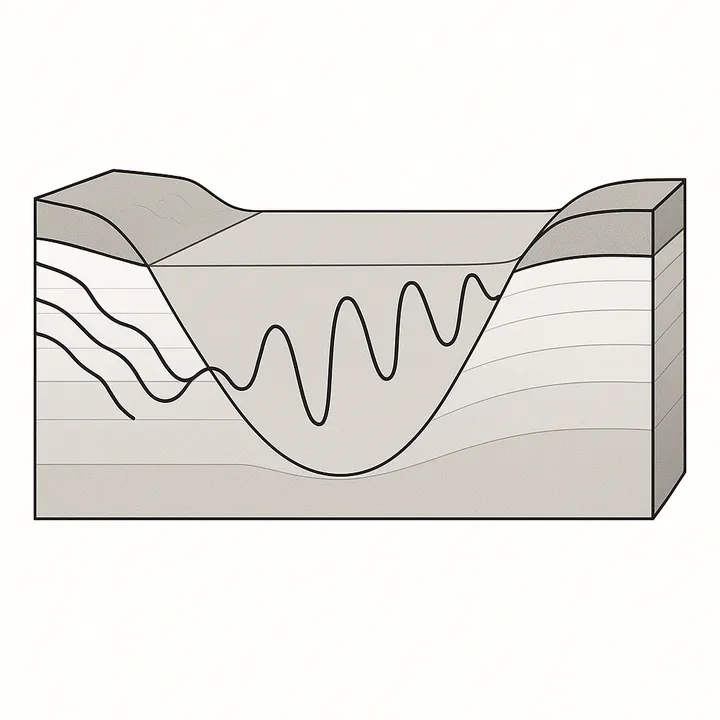 Site-specific basin amplification factors across the Georgia sedimentary basin
This project quantifies long-period spectral acceleration amplification due to the Georgia sedimentary basin in Metro Vancouver.
Using a suite of 30 broadband simulations of M9 Cascadia Subduction Zone earthquakes, we benchmark ground motions against national models and derive period-dependent basin amplification factors (BAFs). These factors are validated using empirical data from the 2001 Nisqually earthquake and used to propose a framework for modifying Uniform Hazard Spectra (UHS) to better reflect the amplification effects.
The findings have implications for seismic hazard mapping, performance-based design, and future editions of the National Building Code of Canada.
📰 Related Publication
📖 Journal Article
- Spectral Acceleration Basin Amplification Factors for Interface Cascadia Subduction Zone Earthquakes in Canada’s 2020 National Seismic Hazard Model (Earthquake Spectra, 2023)
- Impacts of Simulated M9 Cascadia Subduction Zone Earthquakes Considering Amplifications due to the Georgia Sedimentary Basin on Reinforced Concrete Shear Wall Buildings (Earthquake Engineering & Structural Dynamics, 2021)
🎤 Conference Presentation
- Quantifying Basin Amplification in Southwest BC from Simulated M9 Cascadia Subduction Zone Earthquakes (17th World Conference on Earthquake Engineering, Sendai, Japan - 2020)
- Proposed basin amplification factors for subduction interface hazard in the 2020 seismic hazard model of Canada (12th US National Conference on Earthquake Engineering, Salt Lake City, US - 2022)
👥 Collaborators
- Carlos Molina Hutt
- Sai Mithra Dyaga
- Hadi Ghofrani
- Sheri Molnar