Collapse Risk of Tall Nonductile Reinforced Concrete Shear Wall Buildings
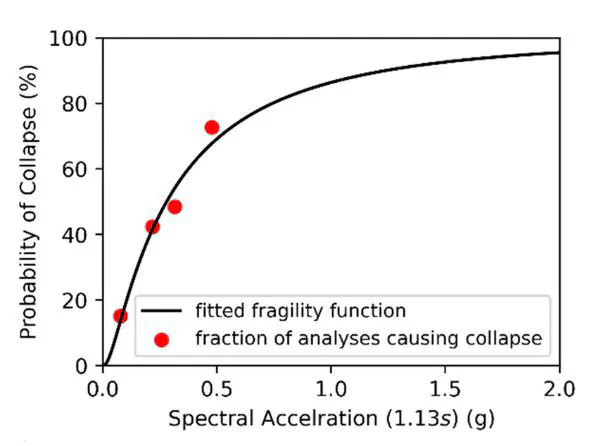 Example collapse fragility function
Abstract
Existing buildings, particularly those predating modern building codes, pose significant seismic risk in regions of high seismicity worldwide. In the City of Vancouver, British Columbia, Canada, reinforced concrete shear wall (RCSW) buildings are prevalent in the construction of tall buildings. Many of these buildings were constructed before the introduction of ductility requirements in the Canadian concrete standard during the mid-1980s, and they predominantly serve as residences for renters, seniors, and low-income populations. This study quantifies the collapse risk of these tall nonductile RCSW buildings to understand their seismic vulnerability. Leveraging a comprehensive database of pre-1980 RCSW buildings, a framework is proposed to generate representative archetypes using a random forest regression model. An automated workflow is developed to facilitate nonlinear structural analyses of these buildings, and a sample of 25 archetypes of varying heights, i.e., 10–30 stories, is selected to evaluate their seismic performance. The results indicate a high risk of collapse, ranging from 9% to 29% in 50 years, significantly higher than the collapse risk target of 1% in 50 years in US standards. The results also indicate that collapse risk can be significantly underestimated when (1) taxonomy-level fragility functions are employed to characterize the performance of this unique typology of buildings, and (2) when the ground motion amplification effects of the Georgia sedimentary basin below Metro Vancouver are neglected.
Type
Publication
Journal of Structural Engineering